Your Adobe Commerce or Magento Open Source project is a web application and, just like any other apps, it also requires regular upgrades which eventually confirm – customers’ and business data security, operational stability, success and up-to-date PCI compliance of your store.
As a merchant, you must have strong leadership team, clear business missions and visions. From business operational perspectives, you can invest in latest technology solutions, hire resources with defined roles and responsibilities to manage various business processes. However, if you graciously miss out strategising and planning upgrades of your Adobe Commerce/Magento application, the eventual consequences can have multitude negative impacts on your business. And, as a person with higher authority in your organisation, you have to consider this opportunity gap as technical debt.
A technical debt doesn’t only revolve around developers code deliverables. In fact, the magnitude of technical debt can start at the very top of the organisational hierarchy.
Let’s see how this can be related to technical debt. Let me entail some analogies below.
Technical debt, is generally used in application development field to describe the amount of unfinished bugs or code refactoring tasks against budget and time constraints.
On the other hand, in the higher level of your organisation, a decision can now be taken to add enhancements to your commerce store. Even though, the underlying decision taken is to be market-competitive, however, at one point, this can lead down to the wrong path thus creating technical debt.
Considering the preceding scenario, if you shift your focus to Adobe Commerce/Magento upgrades scenarios, it would appear as obvious that; being not aware of or by not taking decision at the top level of your organisation to apply regular security patch upgrades or timed long-term upgrades, your application becomes vulnerable in terms of – stability, performance and most critically, reliability, especially during peak network data traffic.
Just like bugs in codes or non-performant codes written by developers, being behind application framework upgrades, poses a significant level of risks to business which is the source of generating revenue.
So, it is imperative for you to know, the starting and eventual affects of not applying regular security patch upgrades or timed long-term upgrades.
It can often seem the right choice to postpone investment in maintenance, upgrade and paying down tech debt. You will be surprised to hear that, while that might work over the short term, the impacts of tech debt can build up over time and lead to serious consequences. From time to time, I have been observing that, irrespective of the business size, many Adobe Commerce/Magento OS merchants fell into this pitfall.
To highlight the significance of organisation technical debts, I would start with following executive-level questions:
- Why upgrades?
- What are the types of upgrades?
- When to plan an upgrade?
- What is the RACI for upgrade?
- How does upgrades impact your business?
1. Why upgrades?
By upgrading your Commerce application, you’re future-proofing the framework and giving yourself the ability towards better and safe customer experiences.
It seems almost too obvious that, the more tech debt is built up, the more your business is at risk. Upgrade debts increase the likelihood of impacting application and services availability and performance. An unwanted outage caused by upgrade debts can see the operation grind to a halt until it is fixed. This eventually incurs significant costs and inferior reputation with your customers and other stakeholders.
As part of RPS (Rapid Planning Strategy), there are 3 major factors you should consider and ask yourself below questions during your annual and quarterly conversations with your eCommerce team.
- Is my site secure? (Security factor)
- Is application framework is optimally performant? (Performance factor)
- What are the cost benefit reasonings between upgrade now as opposed to upgrade later? (Cost factor)
Change and adaptation are the constants to new customer behaviours as such, being on an older platform makes accommodating or imitating new technology experiences more expensive and time-consuming. Or in some cases, it simply may not be even possible. Additionally, as more and more developers move their focus to new technology, the scheduling and cost of retrofitting projects may be prohibitive.
Security Factor
Security is one of the top reasons for upgrading as 83% of security incidents occur on outdated software. According to IBM, the average cost of a data breach is $3.86 million—far greater than what it costs to mitigate this risk through upgrading. Adobe offers two ways to keep your store secure throughout the year:
Performance Factor
Performance is another top reason for upgrading. According to HubSpot, the first five seconds of load time have a significant effect on conversion rates and every second of latency thereafter has a –4.4% impact. That, coupled with the fact that page speed is a leading SEO ranking factor, demonstrates why site performance is a critical element of your site to maintain and regularly improve upon. Each patch release includes performance improvements, so taking advantage of new releases supports your growth plans and keeps your business competitive.
Cost Factor
From executives perspectives, delaying upgrades is the most seen cases which builds up the technical debts without the top-level leadership team is knowing about it. Sometimes, the executives know that, it is growing but aren’t fully aware that it could cause catastrophic problems without warning. The real cost of running an outdated version of any software is much larger and it can have a lasting impact on your business.
Technical debt affects productivity and efficiency negatively. It may start off small but soon it tends to multiply quickly, as does the cost of mitigation.
Another disadvantage of technical debt is that it expedites lowering the morale of developers. Consequently they become less productive and less efficient and less effective code. It can also make it harder to recruit and retain developers. They may not want to work in an environment where they will spend much of their time dealing with old platform and technology stacks.
2. What are the types of upgrades?
Security upgrades
- Patch releases: Include security, performance, quality, and high-priority bug fixes. An upgrade between patch releases can be considered as an upgrade from 2.4.2 to 2.4.3. Security upgrades are the easiest type to implement.
- Security patch releases: Include fixes and enhancements to keep your site secure and are easier to implement. For instance, upgrading from 2.4.5 to 2.4.5-p1.
Feature upgrades
- Minor release upgrades: An upgrade to a minor release is considered as 2.3.x to 2.4.0. These upgrades are more more extensive.
3. When to plan an upgrade?
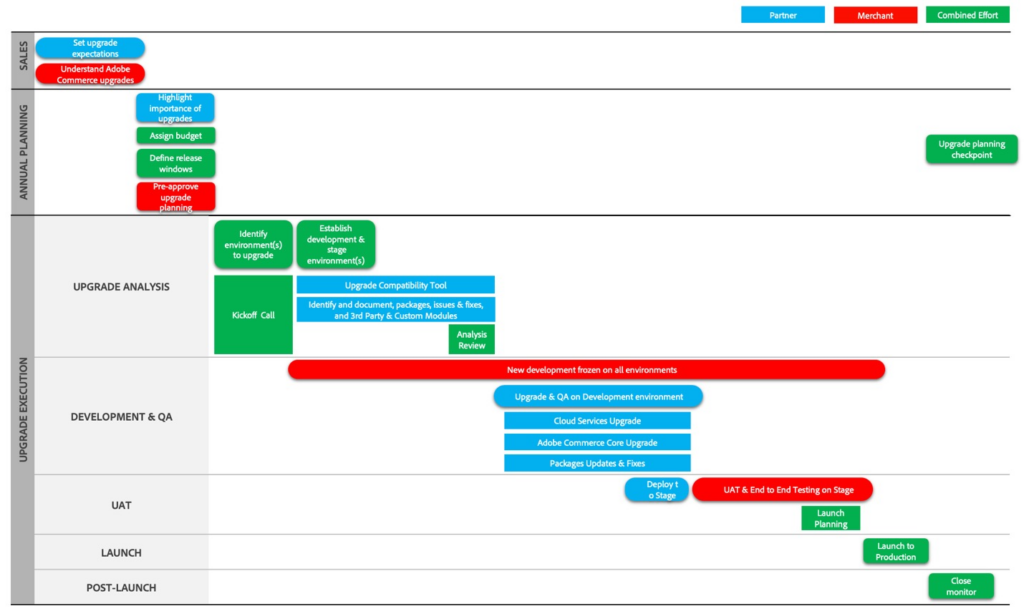
Upgrades require close attention, planning, and management. To help you understand the upgrade journey for Adobe Commerce and Magento Open Source, we describe the process in three main phases:
- Project launch
- The priority to maintain a healthy eCommerce site is just as critical to the success of your business as the site initial launch. And a key aspect of that is proactively planning and preparing for upgrades, that help your site operate as smoothly as possible.
- Annual planning
- It is imperative, during these annual discussions, that you talk about your platform’s health, direction, and upgrade strategy for the year, along with how it fits into the overall goals and KPIs of the business. During quarterly conversations, make sure the annual plan you created is still aligned with your current situation or pivot if not.
- Following the release schedule, assign budget and release windows for upgrades, avoiding holidays, company closures, and peak times. By understanding the Adobe release schedule and staying informed of what changes and improvements are part of each release through the release notes, you can better plan your year.
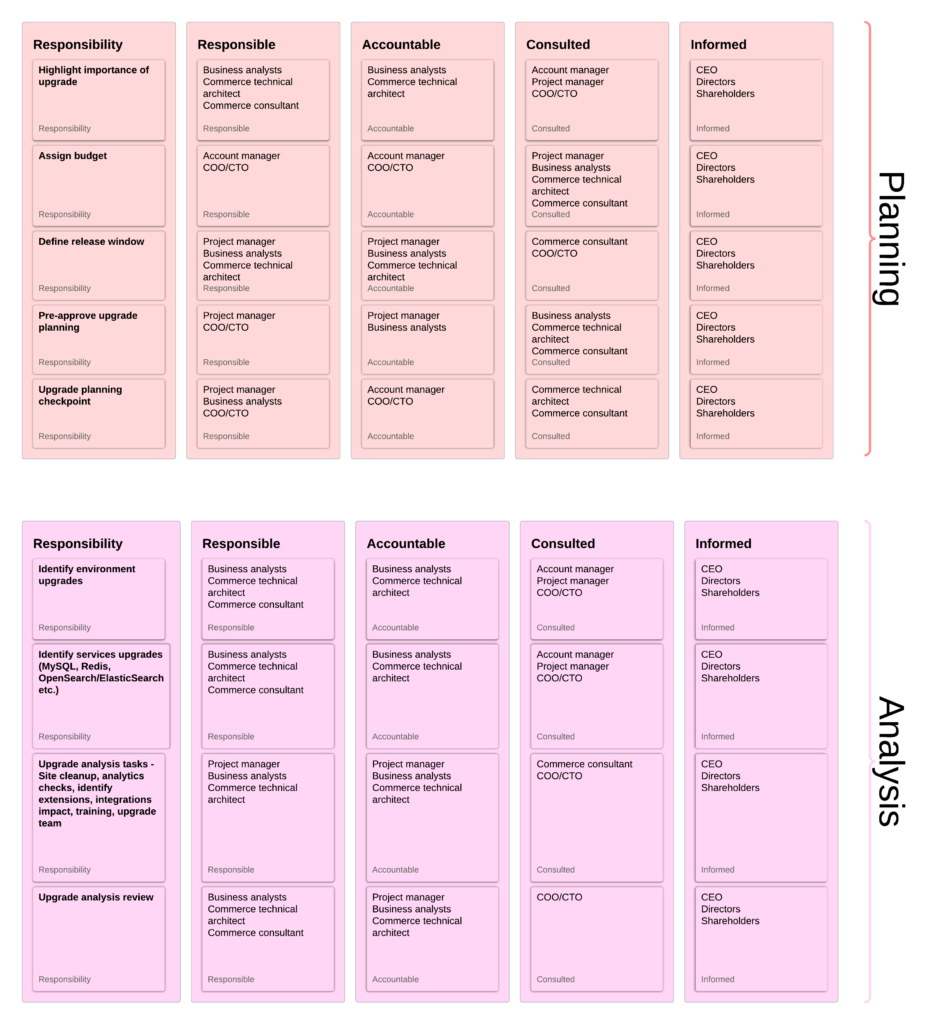
4. What is the RACI for upgrade?
5. How does upgrade impact your business?
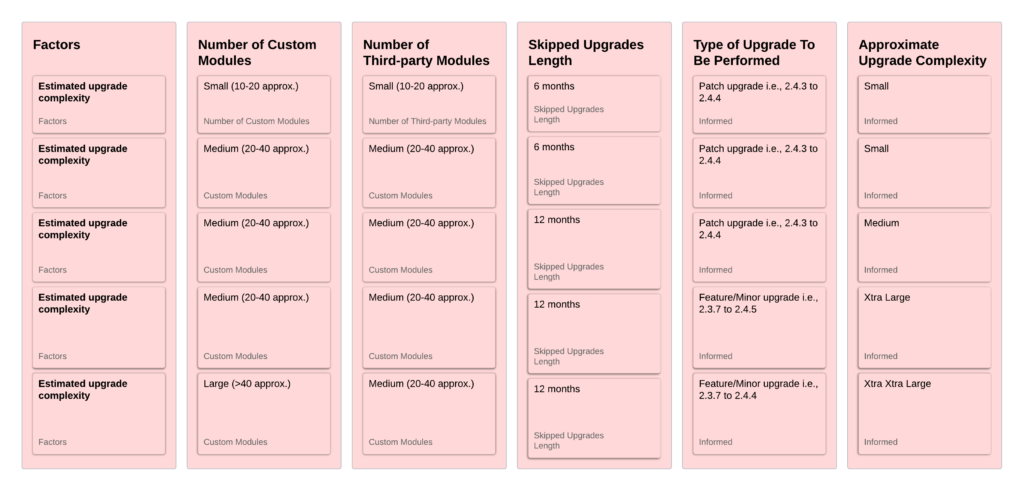
You need to understand the factors that eventually determine the complexity of an upgrade work. Starting from the very early days of the development work, you need to ensure that future upgrades will be performed as smooth as possible. Your development team should always follow Adobe Commerce/Magento Open Source development best practices as described here:
The table below illustrates an approximation of upgrade complexity based on the following factors: